


Starting a Food Franchise: A Complete 2026 Guide

What if the biggest risk in opening a restaurant isn't the quality of your food, but trying to build every system from scratch? Many aspiring owners feel held back by the fear of high failure rates or the confusion of complex NEA regulations in Singapore. It's a common hurdle, and it's okay to feel overwhelmed by the technical side of kitchen operations. Finding a reliable food franchise for small entrepreneurs can turn that uncertainty into a structured, energetic start for your new career.
You deserve a clear roadmap to business ownership that doesn't require decades of experience or an endless budget. We are going to show you exactly how to launch a successful brand by leveraging proven models and professional operational support. This guide covers the essential steps for 2026, from securing prime spots in locations like Grantral Mall to mastering supply chain management. Discover how a multi-brand approach can simplify your daily routine and help you achieve the financial independence you have been working toward.
Table of Contents
What is a Food Franchise for Small Entrepreneurs?
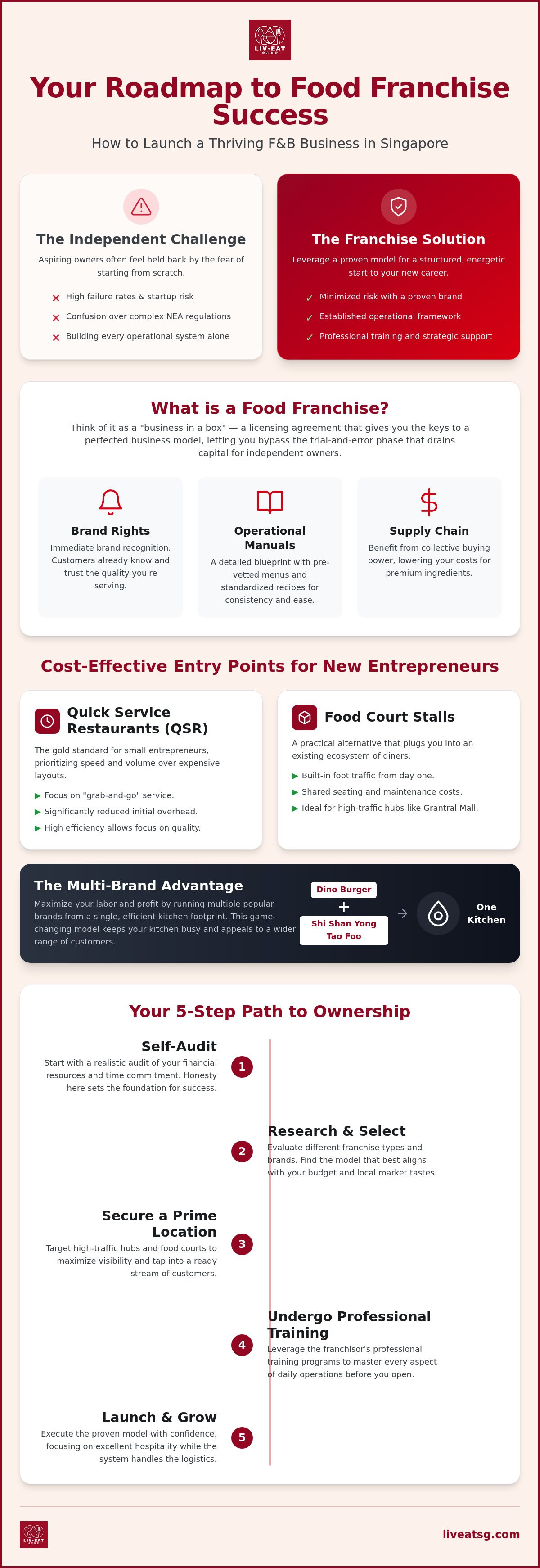
Think of a franchise as a shortcut to success. Instead of spending years testing recipes and failing at marketing, you are paying for the right to use a business model that someone else has already perfected. If you have ever wondered what is franchising? at its core, it is a licensing agreement. You get the keys to a brand name, their secret recipes, and their operational blueprint. For anyone looking for a food franchise for small entrepreneurs, this means you aren't starting from a blank page with zero guidance. You're stepping into a system designed to work from day one.
For many, the biggest hurdle is fear. The F&B industry is notoriously tough, and the "startup risk" of a new restaurant can be paralyzing. Choosing a food franchise for small entrepreneurs minimizes this risk by providing three vital components: brand rights, detailed operational manuals, and a solid supply chain. You don't have to worry about where to source your ingredients or how to train your staff. These systems are already built, vetted, and ready for you to execute.
The year 2026 marks a turning point for the Singapore F&B landscape. We're seeing the rise of "micro-franchising," a model focused on lean footprints and high efficiency. With food-away-from-home prices seeing a 3.4% increase as of June 2026, consumers are flocking to reliable, high-value brands. This shift makes it the perfect time for entrepreneurs to enter the market through established hubs like Grantral Mall MacPherson, where the infrastructure for success is already in place.
The Core Benefits of the Franchise Model
Immediate brand recognition is your greatest asset. When you open a stall, you don't need to spend months convincing people to try your food. If you're serving Hai Cheng Prawn Noodle or Dino Burger, customers already know the quality they're going to get. This built-in trust slashes your initial marketing spend. Additionally, you benefit from:
Consistency: Pre-vetted menus and standardized recipes ensure that every dish meets high standards.
Bargaining Power: Being part of the Liv.Eat Franchise Program gives you collective buying power, lowering your costs for premium ingredients.
Operational Ease: You receive a "business in a box," allowing you to focus on hospitality rather than logistics.
Franchising vs. Independent Ownership: A Quick Comparison
Solo intuition is a gamble; systems are a strategy. Independent owners often face a steep learning curve, spending their first year in a "trial and error" phase that drains capital. Franchises bypass this entirely. You get a mentor in the form of your franchisor, providing a support network that a lonely founder simply doesn't have. With the SBA cumulative loan limit recently doubling to $10 million, more entrepreneurs are finding the financial backing needed to invest in these proven models. It's the difference between guessing your way to a profit and following a map that's already been drawn.
Evaluating the Best Franchise Types for Limited Budgets
Budget constraints don't have to be a barrier to your dreams. In fact, starting small is often the smartest way to enter the F&B world. Quick Service Restaurants (QSR) have become the gold standard for a food franchise for small entrepreneurs because they prioritize speed and volume over expensive dining room layouts. By focusing on a "grab-and-go" or "counter-service" model, you can significantly reduce your initial overhead. This lean approach allows you to focus your resources on what truly matters: high-quality ingredients and efficient service.
Location choice is your next big decision. While a standalone shop might seem prestigious, the high rent and utility costs can quickly eat into your margins. Food court stalls are a much more practical alternative for those starting out. These spaces offer built-in foot traffic, shared seating areas, and lower maintenance costs compared to independent units. Before signing any papers, it's wise to consult a resource like the SBA guide to buying a franchise to ensure you're evaluating the financial commitment correctly. This research helps you understand the balance between lower rent and the royalty fees typically associated with proven systems.
The Rise of Multi-Concept Kitchens
One of the most exciting shifts in 2026 is the "Multi-Brand" advantage. Imagine running Shi Shan Yong Tao Foo and Dino Burger from a single kitchen footprint. This model is a game-changer for a food franchise for small entrepreneurs because it maximizes your labor. Your staff can prepare diverse menu items simultaneously, ensuring that your kitchen stays busy throughout the day. By sharing common ingredients across different brands, you also reduce food waste and simplify your inventory management. You can capture the "healthy lunch" crowd with vegetarian options like Zuya Vegetarian while still serving comfort food to the dinner rush.
Micro-Franchises and Kiosk Models
If you're looking for the lowest possible entry point, micro-franchises and kiosks are the answer. These models feature simplified menus that don't require a full team of specialized chefs. They're designed for efficiency and can be managed by a small, dedicated crew. The food court Grantral Mall serves as a perfect incubator for these models, providing a high-energy environment where new owners can learn the ropes without the pressure of a massive facility. This setup allows you to test the waters and build your confidence before scaling up. If you're ready to explore these options, you might want to check out modern franchise opportunities that fit your specific budget and goals.
A Step-by-Step Guide to Starting Your Food Franchise
Launching your own business is a thrilling journey, but it requires a disciplined approach to ensure your investment pays off. The first step is a rigorous self-audit. Be honest about how much capital you can comfortably commit and how many hours you can realistically spend on-site each week. A food franchise for small entrepreneurs isn't just a financial asset; it's a commitment to serving your community. Once your personal audit is complete, get out on the street. Research the local market by observing foot traffic at various times of day. A spot that's busy on a Friday night might be a ghost town on a Monday morning, so you need to see the full picture.
Next, you must dive into the legalities. Review the Franchise Disclosure Document (FDD) with a fine-tooth comb. This document is your roadmap to the franchisor's history, fees, and expectations. For a deeper understanding of your rights and what to expect during the process, the FTC's Consumer Guide provides essential context on what to look for in these agreements. After the legal hurdles, focus on securing your necessary licenses. Completing staff training early ensures that when your grand opening arrives, your team is ready to deliver a seamless experience that builds immediate momentum and keeps customers coming back for more.
Navigating Singaporean F&B Regulations
Singapore maintains world-class standards for food safety. Mastering SFA food hygiene certifications is a non-negotiable part of your setup. Choosing a partner with an established vegetarian food Tai Seng presence can simplify the permit approval process because the operational systems are already proven in the local context. Don't overlook the power of B2B revenue. Integrating into the Corporate Dining Discount Programme can provide a steady stream of office lunch crowds that independent shops often struggle to reach.
Financing Your Venture
Money matters, so explore every avenue available to you. While SBA loans are a popular choice, especially with the cumulative loan limit rising to $10 million in 2026, you should also investigate F&B-specific grants available within Singapore. Calculate your break-even point with a realistic 2026 timeline in mind. Most successful owners suggest planning for a 12 to 18-month window to reach full stability. Always budget for hidden costs like insurance, marketing, and emergency repairs. Having a financial cushion ensures that a sudden equipment failure doesn't become a business-ending crisis. It's about being prepared for the unexpected while you focus on growth.
Common Pitfalls and How to Overcome Them
Many people dive into the F&B world thinking a franchise is a set and forget investment. This is a dangerous misconception. A food franchise for small entrepreneurs requires active, daily involvement to ensure the high standards of the brand are met. If you aren't on the floor or closely monitoring your systems, small errors in service or cleanliness can snowball into a reputation crisis. Success comes to those who treat their outlet as a passion project rather than just a line on a spreadsheet. You've got to be present to lead your team and connect with your guests.
Another common trap is following brand standards so rigidly that you ignore what your customers actually want. While consistency is vital, you must listen to local feedback. This is where the multi-brand model really shines. If a specific side dish from Dino Burger isn't hitting the mark with your local crowd, you have the flexibility to lean into other concepts like Shi Shan Yong Tao Foo. This agility allows you to pivot your focus without the massive cost of rebranding an entire independent restaurant. It's about being smart with your resources and staying responsive to the market's heartbeat.
Managing the "Labor Crunch" in Singapore
Labor is the biggest hurdle for any food franchise for small entrepreneurs in 2026. High turnover can devastate your margins and morale. To overcome this, leverage the training programs provided by your franchisor. These programs are designed to turn new hires into experts quickly. Cross-training is another powerful tool. By teaching your team to handle tasks for both Zuya Vegetarian and Crunchy Chicken, you create a more versatile workforce that can adapt to different peak hours. Implementing self-order kiosks also helps lean out your operations, allowing your staff to focus on food quality rather than manual order taking.
Maintaining Quality Control
Food consistency is the primary driver of repeat customers. If the meal doesn't taste the same every time, they simply won't come back. Standardized supply chains are your best defense against taste drift. These systems ensure that every ingredient, from the sauce in your Hai Cheng Prawn Noodle to the patties in your burgers, is identical across all outlets. Regular audits might feel like a chore, but they are actually a gift. They provide an objective look at your operations, helping you catch small issues before they become expensive problems. If you're ready to build a business with a support system that helps you avoid these traps, you can apply for the Liv.Eat Franchise Program today and start your journey with a proven framework.
The Liv.Eat Franchise Program: Your Path to Ownership
Choosing the right partner is the final piece of the puzzle. The Liv.Eat Franchise Program is designed specifically as a food franchise for small entrepreneurs who want the power of a big brand without the cold, corporate feel. You get access to a vibrant, diverse portfolio that includes everything from the healthy options of Zuya Vegetarian to the hearty comfort of Dino Burger. This variety isn't just for show; it's a strategic way to keep your kitchen busy and your staff engaged from the breakfast rush through to the late dinner crowd.
We help you build a steady customer base through proven revenue drivers that independent stalls often lack. Our Corporate Dining Discount Programme connects you directly with local businesses, ensuring a reliable stream of B2B customers. To tackle the slower evening hours, we implement 30% daily evening promotions that drive foot traffic and reduce food waste. These systems are built to ensure your business stays profitable while providing incredible value to the community. You focus on the hospitality, and we provide the tools to keep the orders coming in.
Why Small Entrepreneurs Choose Liv.Eat
Many international mega-chains have entry barriers that are simply too high for a first-time owner. We take a different approach. We are a community-first organization that values local owner-operators who are ready to take charge of their future. By offering a food franchise for small entrepreneurs with manageable startup costs and low experience requirements, we make business ownership accessible to everyone. Our portfolio includes local staples like authentic prawn noodles MacPherson fans love, ensuring you are serving flavors that the neighborhood already craves. You aren't just buying a business; you're joining a family that supports your growth every step of the way.
Getting Started with Your Application
Your journey begins with an initial consultation where we find the right brand mix for your specific goals. Do you want to focus on plant-based health or quick-service comfort? We'll help you decide based on your interests and the local market. From there, we assist with site selection and layout planning, especially within high-traffic ecosystems like Grantral Mall MacPherson. Our support doesn't end when the ribbon is cut. We provide comprehensive training that covers everything from kitchen operations to digital marketing strategies. As you find your footing, we're right there to help you scale from one stall to a multi-brand empire. It's time to stop dreaming and start building.
Take the First Step Toward Your F&B Dreams
Starting a business is a bold move, but you don't have to walk the path alone. We have explored how a food franchise for small entrepreneurs provides a safer, more structured entry into the vibrant Singapore dining scene. By choosing a model that prioritizes multi-brand kitchen efficiency and high-traffic locations, you can bypass the common hurdles that often trip up independent startups. Success in 2026 is about working smarter, not harder, by leveraging systems that are already built to scale.
The right partnership makes all the difference. When you join our ecosystem, you gain access to a built-in corporate dining audience and receive full operational training to ensure your team is ready for every rush. It's time to turn your passion for food into a sustainable, profitable reality. Launch your F&B future with the Liv.Eat Franchise Program today! We are excited to welcome you into our community and help you grow a business you can be truly proud of.
Frequently Asked Questions
What is the average cost of a food franchise for a small entrepreneur in Singapore?
Costs vary depending on the brand concept and the size of your location. A food franchise for small entrepreneurs is typically more affordable when you choose a kiosk or food court model rather than a standalone restaurant. You'll need to account for the initial franchise fee, kitchen equipment, renovation costs, and a few months of working capital to ensure a smooth start.
Do I need prior restaurant experience to buy a food franchise?
You don't need a background in professional cooking to succeed in this industry. Most modern franchise programs are built with a "low experience needed" approach, providing you with comprehensive operational manuals and hands-on training. The goal is to give you a repeatable system so you can focus on managing your team and providing great service to your guests.
How long does it typically take to open a franchise stall?
The timeline generally ranges from three to six months once you have secured a suitable location. This period covers your initial training, the kitchen fit-out, and obtaining necessary approvals from the SFA. Having a franchisor to guide you through the regulatory paperwork can significantly speed up the process and help you avoid common administrative delays.
What is a multi-brand food franchise and how does it work?
This model allows you to run multiple concepts, such as Zuya Vegetarian and Dino Burger, from a single kitchen footprint. It's a smart way to maximize your labor and rent efficiency by serving different customer demographics throughout the day. You can capture the healthy lunch crowd and the comfort food dinner rush without needing two separate storefronts.
Are there specific grants for F&B franchises in Singapore?
Singapore offers several support schemes through Enterprise Singapore to help with productivity and technology adoption in the F&B sector. Many owners look into the Productivity Solutions Grant (PSG) to help offset the costs of automated kitchen equipment or point-of-sale systems. It's always best to check the latest government portals for current eligibility criteria and application deadlines.
What kind of ongoing support should I expect from a franchisor?
You should expect continuous assistance with digital marketing, supply chain logistics, and regular operational audits. A dedicated partner provides updated menu items and seasonal promotions to keep your business competitive. This ongoing support ensures you aren't alone when you're facing market shifts or need to troubleshoot a technical issue in your kitchen.
Can I run a food franchise as a side business?
It's possible to run a food franchise for small entrepreneurs alongside another career, but it requires a very reliable on-site manager. F&B is a hands-on industry that demands daily attention to food quality and hygiene standards. If you can't be there yourself, your systems must be strong enough to maintain the brand's reputation without constant supervision.
How do I choose between a vegetarian and a non-vegetarian franchise?
Base your decision on local market demographics and current dining trends in your target area. Vegetarian options like Zuya Vegetarian are growing in popularity as more people prioritize wellness and sustainable eating. However, a multi-brand approach is often the best solution, as it allows you to offer a variety of choices that satisfy every member of a dining group.
Comments